Percentages show up everywhere: discounts, grades, salary raises, price changes, and growth reports. The good news is that almost every percentage problem uses one of a few simple formulas. This guide walks through percentage increase, percentage decrease, discounts, and “what percent of” questions with worked examples.
How to calculate percentage increase
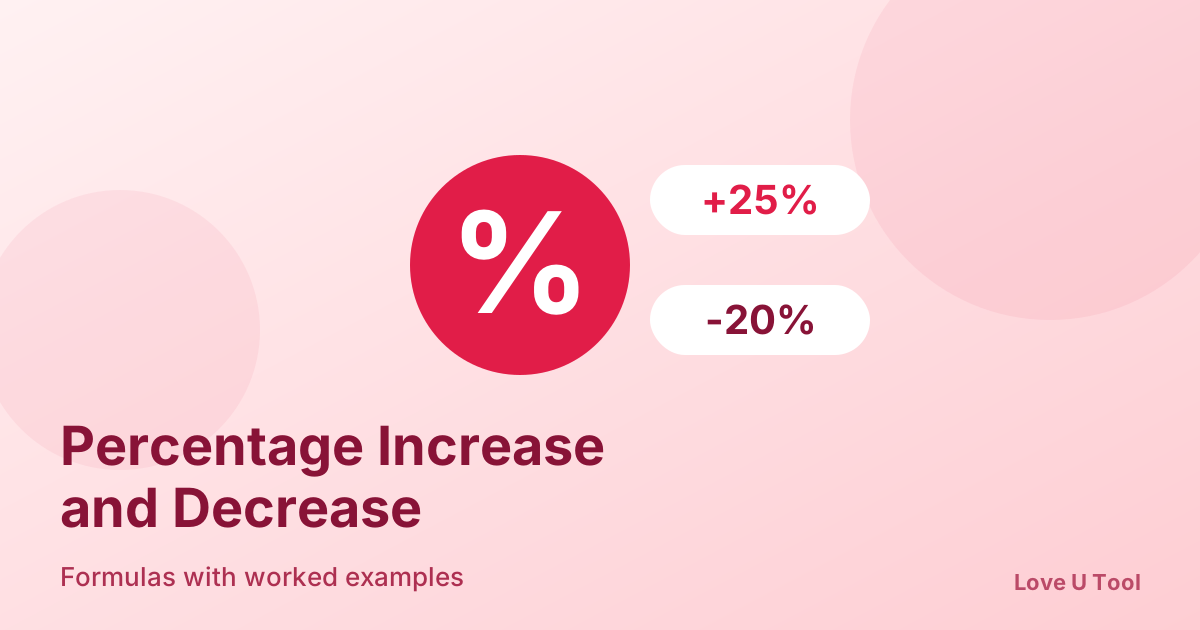
Formula: percentage increase = (new value − old value) ÷ old value × 100. Example: a price rises from 80 to 100. The change is 20, so 20 ÷ 80 = 0.25, and 0.25 × 100 = 25%. The price increased by 25%.
How to calculate percentage decrease
Formula: percentage decrease = (old value − new value) ÷ old value × 100. Example: a phone drops from 500 to 400. The change is 100, so 100 ÷ 500 = 0.2, which is a 20% decrease.
How to find a percentage of a number
Formula: part = percentage ÷ 100 × whole. Example: what is 15% of 240? 15 ÷ 100 = 0.15, and 0.15 × 240 = 36.
What percent is one number of another?
Formula: percentage = part ÷ whole × 100. Example: you scored 42 out of 60. 42 ÷ 60 = 0.7, so you scored 70%.
How to calculate a discount
Discount amount = original price × discount % ÷ 100. Sale price = original price − discount amount. Example: a 1,200 jacket with 30% off has a discount of 360, so the final price is 840. A shortcut is to multiply the original by (100 − discount) ÷ 100, which is 1,200 × 0.70 = 840.
Percentage change vs percentage points
If an interest rate goes from 4% to 5%, it rose by 1 percentage point, but the percentage increase is 25% (1 ÷ 4). Mixing these up is one of the most common mistakes in news and reports, so always check which one is meant.
Markup vs margin
- Markup = (selling price − cost) ÷ cost × 100.
- Margin = (selling price − cost) ÷ selling price × 100.
- Example: cost 60, selling price 100. Markup is 66.7%, margin is 40%.
Check your answer with a calculator
Do the math yourself to understand it, then confirm with the Percentage Calculator to avoid slips in budgets, invoices, and assignments. Writing a report? Run the final text through the Word Counter to make sure it fits the required length.
Frequently asked questions about percentages
Why is the percentage increase different from the percentage decrease?
Because the base changes. Going from 100 to 150 is +50%, but going back from 150 to 100 is only about −33.3%, since the percentage is measured against a different starting value.
How do I add a percentage to a number?
Multiply the number by (1 + percentage ÷ 100). For example, adding 18% to 500 gives 500 × 1.18 = 590.
How do I reverse a percentage?
To find the original price before a 20% discount, divide the sale price by 0.80. If an item costs 800 after 20% off, the original was 800 ÷ 0.80 = 1,000.